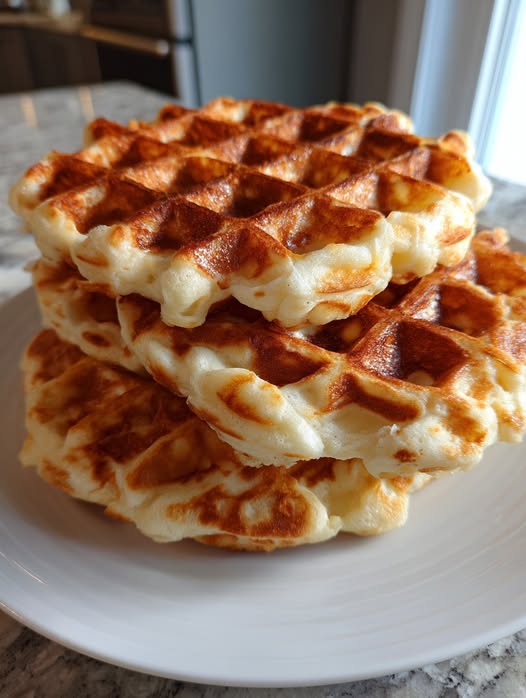
3 – Ingredient Cottage Cheese Protein Waffles – Ultra Deep Masterclass
Introduction & Background
The 3-Ingredient Cottage Cheese Protein Waffles represent a complete rethinking of what a waffle actually is. Traditionally, waffles are part of European culinary history, originating from early batter-based cakes cooked between patterned iron plates. Over time, they evolved into sweet breakfast items loaded with flour, sugar, butter, syrup, and sometimes even dessert toppings.
While delicious, classic waffles are structurally simple but nutritionally imbalanced—high in refined carbohydrates and low in sustained protein.
This modern version flips the concept entirely.
Instead of treating waffles as a dessert-like breakfast, this recipe transforms them into a high-protein, low-complexity functional food system. It is designed for people who want:
- Fast preparation
- Minimal ingredients
- High satiety
- Muscle-supportive nutrition
- Low sugar impact
The key innovation is the use of cottage cheese as a structural protein base, which replaces the need for heavy flour, butter, and sugar.
Cottage cheese behaves uniquely in heat-based cooking systems:
- It melts into creamy curds
- It integrates moisture evenly
- It provides slow-digesting casein protein
- It enhances softness without weakening structure
When combined with eggs and a minimal binding agent, it creates a batter that transforms into waffles that are:
- Crisp and golden on the outside
- Soft, creamy, and slightly custard-like inside
- High in protein density
- Naturally filling for long hours
This recipe is not just about making waffles—it is about building a protein architecture system using only essential ingredients.
Chef’s Philosophy & Minimal Ingredient Engineering System
This recipe is built on one strict principle:Every ingredient must contribute to structure, texture, or nutrition—nothing is decorative.
There is no sugar, no butter, and no flavor fillers required for success.
1. Protein Matrix Formation Theory
Instead of relying on flour-based structure, this recipe uses a protein-first architecture:
- Cottage cheese → slow-digesting protein matrix
- Eggs → heat-stable binding proteins
When heated, these proteins coagulate and form a stable internal waffle structure.
This is similar to how custards set—but with added structural density.
2. Moisture Control Engineering System
Cottage cheese contains significant moisture. Without control, this can cause:
- Soggy waffles
- Weak structure
- Poor crisp formation
This recipe solves that through:
- Controlled flour/oat absorption
- Egg protein stabilization
- High-heat waffle iron sealing
The goal is moist inside, crisp outside—not wet or dense.
3. Crisp Formation Chemistry (Maillard Reaction Optimization)
Crispiness in waffles comes from the Maillard reaction:
- Proteins + heat + low surface moisture → browning and crunch
To optimize this:
- Batter is thickened properly
- Waffle iron is fully preheated
- Cooking time is not rushed
This ensures golden crust development and flavor depth.
4. Satiety Engineering (Why This Keeps You Full)
This recipe is highly filling due to:
- Casein protein (slow digestion)
- Egg protein (moderate digestion)
- Fiber from oats (if used)
This combination creates:
- Long-lasting energy
- Reduced hunger spikes
- Stable blood sugar response
It functions more like a nutritional meal replacement than a snack.
Difficulty, Timing & Yield
Difficulty Level: Easy
Preparation Time: 5–8 minutes
Cooking Time: 8–12 minutes
Total Time: ~15–20 minutes
Servings: 2–3 large waffles
Ingredients (3 Core Ingredients Only – Fully Explained)
1. Cottage Cheese (Protein + Moisture Core)
- 1 cup cottage cheese
This is the foundation ingredient.
Functional roles:
- Provides high-quality casein protein
- Creates creamy internal texture
- Adds moisture without needing milk or butter
- Softens waffle interior naturally
The texture of cottage cheese directly influences final waffle softness.
2. Eggs (Structural Binding System)
- 2 large eggs
Eggs are essential for:
- Binding all ingredients into a stable batter
- Providing structural integrity during heat exposure
- Creating lift and lightness inside waffle pockets
- Preventing crumble after cooking
Egg proteins solidify under heat, forming the internal skeleton of the waffle.
3. Oats or Flour (Structural Reinforcement Agent)
Choose one:
- 1/2 cup rolled oats (blended into flour) OR
- 1/2 cup all-purpose flour OR
- 1/2 cup almond flour (low-carb version)
Functional roles:
- Absorbs excess moisture from cottage cheese
- Helps crisp outer layer formation
- Stabilizes batter viscosity
- Prevents collapsing during cooking
This is the structural control system of the recipe.
Step-by-Step Method (Advanced Texture Engineering Process)
Step 1: Batter Formation (Protein Integration Phase)
Add into blender:
- Cottage cheese
- Eggs
- Oats/flour
Blend thoroughly until completely smooth.
This step ensures:
- No curds remain
- Protein is evenly distributed
- Batter becomes homogeneous
The final mixture should look like a thick, creamy protein batter.
Step 2: Batter Consistency Calibration
Check texture carefully:
Ideal batter state:
- Thick but pourable
- Smooth with no lumps
- Slight resistance when poured
Adjust if needed:
- Too thick → add 1–2 tbsp milk
- Too thin → add extra oats/flour
Consistency determines waffle structure quality.
Step 3: Waffle Iron Thermal Preparation
Preheat waffle iron fully before adding batter.
This is critical because:
- Immediate heat locks structure
- Prevents sticking
- Activates Maillard browning early
Light greasing may be used if required.
Step 4: Cooking Phase (Structural Formation Process)
Pour batter into waffle iron carefully.
Close and cook for:
5–8 minutes minimum
Do NOT open early.
Inside the waffle iron:
- Egg proteins coagulate → structure formation
- Cottage cheese melts → creamy pockets form
- Flour/oats stiffen → external crisp shell develops
This is where transformation happens.
Step 5: Crisp Development & Stabilization Phase
Once golden brown:
Remove carefully and place on rack.
Let rest for:
1–3 minutes
During this phase:
- Steam escapes
- Exterior crisp strengthens
- Internal moisture stabilizes
This prevents soggy waffles.
Advanced Chef Tips (Professional Level Optimization)
- Always blend fully for bakery-level smoothness
- Use slightly thick batter for best structure
- Resting after cooking is mandatory for crisp texture
- Do not overload waffle iron
- For extra crisp: extend cook time by 1–2 minutes
- For softer texture: reduce oats slightly
Common Mistakes & Failure Analysis
1. Soggy Waffles
Cause:
- Too much moisture in cottage cheese
- Undercooking
Fix:
- Blend thicker batter
- Cook longer until crisp edges form
2. Broken Structure
Cause:
- Opening waffle iron too early
Fix:
- Always wait full cook cycle
3. Dense Texture
Cause:
- Too much flour or overmixing after blending
Fix:
- Maintain balanced batter ratio
4. Raw Center
Cause:
- High heat outside, low cook time
Fix:
- Reduce heat slightly, increase time
Storage & Meal Prep Optimization
- Refrigerate: up to 3 days
- Freeze: up to 1 month
- Reheat: toaster or air fryer only
- Avoid microwave (removes crisp structure)
Best reheating method restores:
- Exterior crunch
- Interior softness
- Fresh waffle feel
Serving Variations (Optional Enhancements)
Even though this is a 3-ingredient base recipe, it can be styled differently:
- Sweet version: banana slices + honey drizzle
- Savory version: egg + avocado topping
- Fitness version: Greek yogurt + berries
- Dessert version: cocoa + peanut butter drizzle
Final Thoughts
The 3-Ingredient Cottage Cheese Protein Waffles prove that simplicity does not mean limitation.
With only three core ingredients, this recipe achieves:
- High protein density
- Strong structural integrity
- Crisp exterior + soft interior contrast
- Fast preparation time
- Long-lasting satiety
It is not just a quick breakfast—it is a minimalist protein engineering system designed for performance, convenience, and taste efficiency.
Leave a Reply