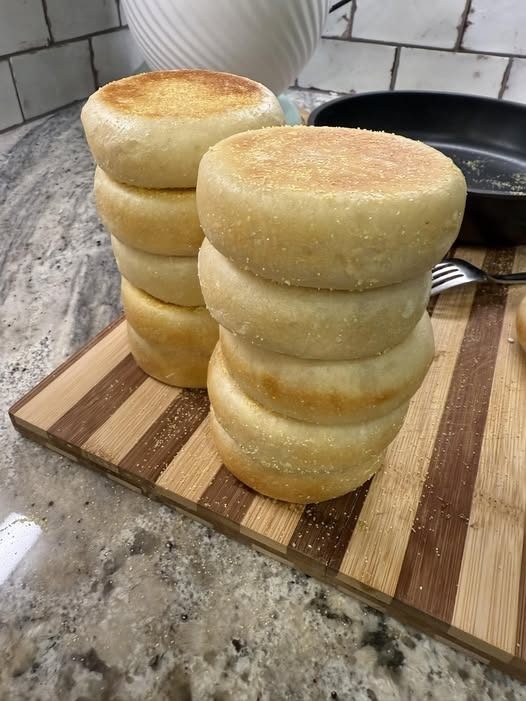
English Muffins – Ultra Deep Masterclass Edition
Introduction & Background
English muffins are one of the most iconic griddle-baked breads in global breakfast culture. Despite the name, they are not muffins in the sweet cake sense, but rather yeast-leavened flat breads cooked on a griddle or pan instead of baked in an oven.
Their origin traces back to England in the 18th–19th century, where they were sold by street bakers known as “muffin men.” These early versions were simple yeast breads cooked on hot griddles and served fresh with butter, jam, or cheese. Over time, English muffins became a breakfast staple in both the United Kingdom and later North America, where they were popularized commercially and became a foundation for dishes like eggs Benedict and breakfast sandwiches.
What makes English muffins unique is not just their taste, but their texture architecture:
- Soft and airy interior crumb
- Slight chew from gluten development
- Golden, lightly crisp exterior crust
- Signature “nooks and crannies” structure inside
These holes are not accidental—they are the result of controlled fermentation, hydration balance, and gentle heat cooking.
This recipe breaks down English muffins as a structured bread system, not just a simple dough.
Chef’s Philosophy & Bread Engineering Thinking
English muffins are built on precision, not complexity.
The entire system depends on four major principles:
1. Fermentation Structure Development
Yeast is not just for rising—it is responsible for:
- Gas formation (air pockets)
- Flavor development (slight tanginess)
- Gluten relaxation over time
- Internal crumb structure formation
Long fermentation = better flavor and more open texture.
2. Hydration Balance Control
English muffin dough is softer than regular bread dough.
- Too dry → dense muffins
- Too wet → flat, unstructured muffins
Proper hydration allows:
- Air pocket formation
- Soft interior texture
- Even cooking on griddle
3. Griddle Cooking Physics
Unlike oven bread, English muffins are cooked using direct surface heat.
This creates:
- Slow internal cooking
- Controlled crust formation
- No harsh oven drying
- Signature pale golden surface
4. “Nooks and Crannies” Formation System
The iconic interior texture comes from:
- Proper dough hydration
- Gentle shaping (no over-deflation)
- Slow fermentation gas retention
- Minimal kneading after proofing
These trapped gas pockets expand during cooking, forming irregular airy holes.
Difficulty, Timing & Yield
Difficulty Level: Medium
Preparation Time: 25–30 minutes
Fermentation Time: 1.5–3 hours (or overnight for best results)
Cooking Time: 15–20 minutes
Total Time: 3–6 hours (depending on fermentation method)
Yield: 8–10 English muffins
Ingredients (Fully Structured Breakdown)
1. Flour Base System
- 3 cups all-purpose flour
Function: - Structural backbone
- Gluten formation system
- Crumb stability
Bread flour can also be used for slightly chewier texture.
2. Yeast Activation System
- 2 1/4 teaspoons instant yeast (1 packet)
Function: - Fermentation engine
- Gas production
- Flavor development
3. Liquid Hydration System
- 1 cup warm milk (not hot)
- 1/4 cup warm water (adjust as needed)
Function:
- Activates yeast
- Hydrates flour
- Softens crumb structure
4. Fat & Softness System
- 2 tablespoons butter (melted)
Function:
- Tender crumb formation
- Flavor richness
- Slight softness in bite
5. Sweetness Balance System
- 1 tablespoon sugar or honey
Function:
- Feeds yeast
- Enhances browning
- Balances flavor (not sweetness-heavy)
6. Salt Control System
- 1 teaspoon salt
Function:
- Strengthens gluten
- Balances fermentation
- Enhances overall flavor depth
7. Cornmeal Coating System
- Cornmeal or semolina (for dusting)
Function:
- Prevents sticking
- Creates signature rustic bottom texture
- Adds light crunch layer
Step-by-Step Method (Advanced Bread Craft Process)
Step 1: Yeast Activation Phase
In a bowl, mix:
- Warm milk
- Warm water
- Sugar
- Yeast
Let sit for 5–10 minutes.
You will see:
- Foam formation
- Bubbles rising
This confirms yeast activation.
If no foam appears, yeast is inactive and must be replaced.
Step 2: Dough Formation Phase
Add to yeast mixture:
- Flour
- Salt
- Melted butter
Mix until a sticky dough forms.
This stage creates the base gluten network system.
Step 3: Initial Kneading Phase
Knead dough for 6–8 minutes.
Goal:
- Smooth elasticity
- Soft but structured texture
- Slight tackiness
Do not over-knead—English muffins need softness, not tight gluten.
Step 4: First Fermentation (Bulk Rise)
Place dough in oiled bowl.
Cover and let rise for:
- 1.5 to 2 hours at room temperature
OR - Overnight in refrigerator (best flavor development)
During this phase:
- Yeast produces gas
- Dough expands
- Flavor deepens
Step 5: Shaping Phase (Critical Texture Control)
Gently deflate dough.
Divide into equal portions.
Shape into round discs.
Important rules:
- Do NOT roll aggressively
- Do NOT over-compress dough
- Keep air inside
This preserves “nooks and crannies” potential.
Step 6: Cornmeal Coating Phase
Lightly coat both sides with cornmeal.
This:
- Prevents sticking
- Creates rustic crust base
- Enhances griddle texture
Step 7: Second Proofing Phase
Let shaped muffins rest for 30–45 minutes.
This allows:
- Gas redistribution
- Soft expansion
- Final texture relaxation
Step 8: Griddle Cooking Phase (Core Transformation Step)
Heat pan or griddle on low-medium heat.
Cook muffins for:
- 6–8 minutes per side
Do NOT rush heat.
Inside the muffin:
- Dough slowly expands
- Gas pockets form
- Interior structure stabilizes
Exterior becomes golden while inside stays soft.
Step 9: Final Baking Stabilization (Optional but Recommended)
Place cooked muffins in oven at 160°C for 5–7 minutes.
This ensures:
- Fully cooked center
- Stable crumb structure
- Even internal drying
Step 10: Cooling Phase
Let muffins cool on rack.
Do NOT cut immediately.
Cooling allows:
- Crumb stabilization
- Moisture redistribution
- Texture locking
Advanced Chef Tips
- Overnight fermentation improves flavor significantly
- Do not flatten dough too much during shaping
- Low heat griddle is key to even cooking
- Cornmeal is essential for authentic texture
- Always cool before slicing for proper crumb structure
Common Mistakes & Failure Analysis
Dense Muffins
Cause:
- Under-proofing or dead yeast
Fix:
- Ensure active fermentation and proper rise time
No Air Holes Inside
Cause:
- Over-kneading or deflating dough too much
Fix:
- Handle dough gently
Burnt Outside, Raw Inside
Cause:
- Heat too high
Fix:
- Lower griddle temperature and cook longer
Flat Muffins
Cause:
- Weak yeast or over-proofing collapse
Fix:
- Control proof timing carefully
Storage & Meal Prep Optimization
- Room temperature: 2 days
- Refrigerator: up to 5 days
- Freezer: up to 2 months
- Toast before serving for best texture
Serving Suggestions
English muffins are extremely versatile:
- Classic butter and jam
- Eggs Benedict base
- Breakfast sandwich foundation
- Cheese and honey savory version
- Peanut butter and banana fitness snack
Final Thoughts
English muffins are not just bread—they are a controlled fermentation and griddle-cooking system designed for texture precision.
When executed correctly, they deliver:
- Soft airy interior with signature holes
- Light golden crust
- Slight chew and elasticity
- Rich yeast flavor depth
- Perfect sandwich-ready structure
They represent one of the simplest yet most technically elegant forms of breadmaking in home cooking.
Leave a Reply