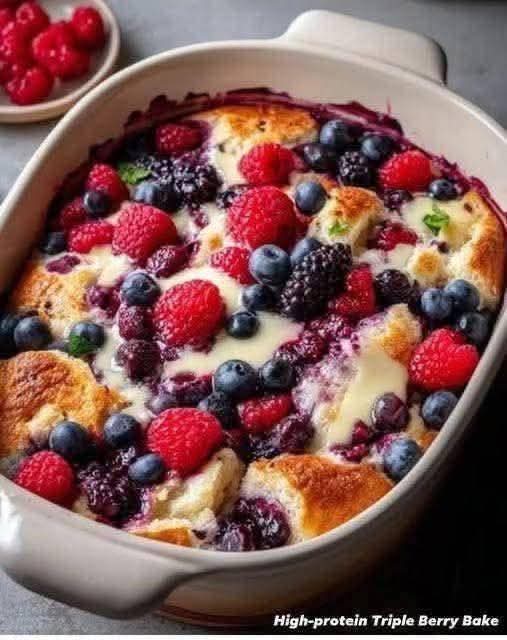
High Protein Triple Berry Breakfast Bake – Ultra Deep Masterclass Edition
Introduction & Background
The High Protein Triple Berry Breakfast Bake is not just a recipe—it is a modern nutritional design built around the idea that breakfast can be both functional and enjoyable at the same time. In traditional food culture, breakfast was often either heavily carbohydrate-based (like bread, porridge, or pastries) or protein-heavy but bland (like plain eggs or meat plates). Very rarely did a single dish combine taste, texture, convenience, and nutrition in a balanced way.
This recipe represents a shift in how we think about morning meals.
In the past, baked breakfast dishes were created mostly out of necessity. People would combine leftover grains, milk, eggs, and fruits into a baking dish to avoid waste and create something filling for the family. Dishes like baked oats, bread puddings, and breakfast casseroles emerged from this practical cooking style across Europe and North America.
Over time, especially with the rise of modern fitness culture, these traditional baked breakfasts evolved into something more intentional. Instead of just being “filling,” they became engineered meals—designed to deliver specific nutritional outcomes like higher protein intake, sustained energy release, and better satiety.
The High Protein Triple Berry Breakfast Bake sits directly in this evolution.
It takes inspiration from baked oatmeal, protein cakes, yogurt bakes, and fruit casseroles, then combines them into a single structured dish that feels like a dessert but functions like a balanced meal. It is soft like cake, slightly custardy in the center, lightly chewy from oats, and bursting with juicy berries.
The “triple berry” concept—usually blueberries, strawberries, and raspberries—is not just for flavor variety. It is a deliberate nutritional and sensory design choice. Each berry contributes something different:
- Blueberries: mild sweetness and antioxidants
- Strawberries: freshness and moisture
- Raspberries: tartness and flavor contrast
When combined, they create a layered fruit profile that prevents the dish from tasting flat or overly sweet.
Chef’s Philosophy & Deep Culinary Thinking
To understand this dish at a professional level, you need to stop thinking of it as a “simple baked breakfast” and start seeing it as a multi-layered structural food system.
The philosophy behind this recipe is based on four major principles:
1. Protein Distribution Architecture
High-protein recipes often fail because protein is treated as a single additive instead of a structural component. Protein powder, eggs, and dairy all behave differently under heat.
In this recipe, protein is distributed across multiple layers:
- Eggs → structure and binding
- Greek yogurt → moisture + protein density
- Milk → hydration and softness
- Optional protein powder → concentration boost
This layered approach prevents the final bake from becoming dry, rubbery, or chalky—common problems in fitness baking.
The goal is not just “high protein,” but protein that integrates naturally into texture.
2. Moisture Engineering (The Most Important Factor)
Moisture is the most critical variable in baked breakfast dishes.
Too little moisture = dry, crumbly, protein-heavy brick
Too much moisture = soggy, undercooked center
Berries complicate this because they release juice during baking. That juice is both a blessing and a challenge. It enhances flavor but can destabilize structure if not balanced correctly.
This recipe solves that by:
- Using oats to absorb excess liquid
- Using eggs to stabilize structure
- Controlling berry distribution instead of overmixing
The result is a controlled moisture environment where every component supports the others.
3. Flavor Layering Through Natural Ingredients
Instead of relying on heavy sugar, syrups, or artificial flavors, this recipe builds sweetness through:
- Natural fruit sugars (berries)
- Light honey or sweetener
- Vanilla extract
- Mild cinnamon warmth (optional)
This creates a more complex flavor profile where sweetness is not overpowering but gradually developed as you eat.
The tartness of raspberries prevents sweetness fatigue, while blueberries soften the acidity, and strawberries bridge the two extremes.
4. Texture Contrast Engineering
A good breakfast bake is not just soft—it is multi-textured.
This recipe intentionally creates:
- Soft custard-like interior (eggs + yogurt)
- Slight chew from oats
- Juicy bursts from berries
- Light crust on top from baking
This contrast is what makes the dish feel “dessert-like” while still being a functional meal.
Difficulty, Timing & Yield (Detailed Breakdown)
- Difficulty Level: Medium (because of moisture and protein balance)
- Preparation Time: 20–25 minutes
- Mixing Time: 10–15 minutes
- Baking Time: 35–45 minutes
- Cooling Time: 20 minutes
- Total Time: ~1 hour 30 minutes
- Servings: 6–8 portions (meal prep friendly)
Ingredients (Expanded Breakdown with Purpose)
Dry Foundation
- 1 cup rolled oats (fiber + structure + absorption)
- 1/2 cup whole wheat flour or oat flour (binding + density control)
- 1–2 scoops vanilla protein powder (optional structural protein boost)
- 1 teaspoon baking powder (controlled rise)
- 1/2 teaspoon cinnamon (flavor depth + warmth)
- Pinch of salt (flavor enhancer, balances sweetness)
Wet Structural Base
- 1 cup Greek yogurt (protein + creaminess + moisture stability)
- 2 large eggs (binding + structure formation under heat)
- 1/2 cup milk (hydration + texture softening)
- 2–3 tablespoons honey or natural sweetener (controlled sweetness)
- 1 teaspoon vanilla extract (aroma + dessert profile enhancement)
Triple Berry System
- 1/2 cup blueberries
- 1/2 cup strawberries (chopped small)
- 1/2 cup raspberries
Each berry behaves differently under heat:
- Blueberries hold shape
- Strawberries release juice
- Raspberries break down slightly for natural sauce effect
Optional Enhancers (Advanced Level)
- Chia seeds (gel formation + fiber boost)
- Flax seeds (nutty flavor + structure stability)
- Almond slivers (crunch contrast)
- Extra yogurt drizzle (post-bake protein topping)
Step-by-Step Method (Deep Technique Explanation)
Step 1: Oven Preparation and Thermal Setup
Preheat oven to 180°C.
This temperature is critical because it allows:
- Protein coagulation without rubberiness
- Slow starch absorption from oats
- Even berry juice release without burning
Line or grease baking dish properly to prevent moisture sticking at edges.
Step 2: Dry Ingredient Integration (Structural Base Formation)
Combine oats, flour, protein powder, baking powder, cinnamon, and salt.
Mix thoroughly.
This ensures:
- Even protein distribution
- Uniform leavening reaction
- No dry clumps in final texture
At this stage, you are essentially building the “skeleton” of the bake.
Step 3: Wet Mixture Emulsion Creation
In another bowl, whisk:
Greek yogurt + eggs + milk + honey + vanilla
Whisk until smooth and fully emulsified.
This step is critical because:
- Yogurt provides thickness
- Eggs provide binding proteins
- Milk adjusts viscosity
This mixture becomes the “hydration system” of the bake.
Step 4: Batter Formation (Controlled Hydration Phase)
Slowly combine wet and dry mixtures.
Stir gently until thick batter forms.
Do NOT overmix.
Overmixing leads to:
- Gluten overdevelopment
- Dense texture
- Loss of softness
Ideal batter should be thick but spoonable, not runny.
Step 5: Berry Distribution Strategy
Add berries in stages:
- Fold 2/3 into batter gently
- Reserve 1/3 for top layering
This ensures:
- Even fruit distribution inside
- Visual appeal on top
- Controlled juice release
Avoid crushing berries during mixing.
Step 6: Pan Loading and Structural Settling
Pour batter into dish.
Spread evenly.
Tap lightly to remove air pockets.
This helps:
- Even baking
- Stable structure
- Consistent texture throughout
Step 7: Baking Phase (Thermal Transformation)
Bake 35–45 minutes.
During baking:
- Eggs coagulate → structure forms
- Oats absorb moisture → thickening occurs
- Berries release juices → natural syrup formation
- Top layer browns → flavor development
This is where chemistry transforms the dish.
Step 8: Cooling and Stabilization
Rest for 20 minutes after baking.
This step allows:
- Internal moisture redistribution
- Structural stabilization
- Easier slicing
Cutting too early will break texture integrity.
Serving Logic
Can be served:
- Warm (dessert-like softness)
- Cold (meal prep texture)
- With yogurt topping (protein boost)
- With nut butter drizzle (energy dense version)
Advanced Pro Tips
- Use thick Greek yogurt only (runny yogurt ruins structure)
- Do not overbake (protein dries fast)
- Frozen berries work but increase baking moisture slightly
- Let it rest fully before slicing
- Adjust sweetness after baking, not before if needed
Common Failures & Why They Happen
- Dry texture → overbaking or too much protein powder
- Soggy center → excess berries or underbaking
- Crumbly structure → insufficient egg binding
- Flat flavor → missing salt or vanilla
Storage & Meal Prep Optimization
- Refrigerate up to 4 days
- Freeze in portions for up to 1 month
- Reheat gently (microwave or oven)
- Best eaten slightly warm for texture balance
Final Thoughts
High Protein Triple Berry Breakfast Bake is not just a healthy recipe—it is a functional food design that merges nutrition science with comfort food psychology.
It proves that healthy eating does not need to feel restrictive. Instead, it can feel soft, sweet, warm, and satisfying while still supporting fitness goals.
When executed properly, it delivers:
- High protein content
- Balanced sweetness
- Soft cake-like texture
- Real fruit freshness
- Long-lasting satiety
It is a breakfast that behaves like a dessert but functions like fuel.
Leave a Reply